Blog
AI, Care Navigation and the Heavy Admin We Don't Talk About
Often we think of life admin as annoying and mundane. Then there's the important and heavy personal tasks.
Finding the right allied health therapist sits firmly in the important but heavy category.
It can be stressful at the best of times, to research new options especially if you have been working with someone for a while and suddenly need to find a new provider. When you know what good support feels like, the idea of starting again can feel like a lot.
When you add in the need for a practitioner trained in a specific approach, the search becomes even more pressured. It's rarely as simple as searching for practitioners near you.
You might need someone trained in a particular evidence-based approach. You might need them to work with a specific type of need, be within a realistic travel distance, and have enough public information available for you to decide whether they are worth contacting. You might also need to check whether they are registered, certified or publicly listed in the right place.
Recently, I helped with exactly this kind of search.
This week, I used Codex to help with the first-pass research. Not to make the decisions, and not to recommend providers, but to reduce the heavy manual burden of getting from "where do we even start?" to a shortlist that could actually be reviewed.
Why normal search is not enough
A simple search like "physio near me" or "speech therapist near me" does not really help when the criteria is specific.
A general search can show you the nearest providers, paid ads at the top, Google Maps results and a long list of websites that may or may not mention the approach you need. And that is only the start.
You still have to refine your search terms, try different keywords, open individual websites, check whether the practitioner has the right training, look for contact details, copy information into a document, check locations, compare reviews, and work out whether each option is actually relevant.
Then, once you have done all that, you still need to contact people. Sometimes by phone or email, and sometimes more than once.
Because many allied health therapists are in high demand, some may not be taking new clients or may have long waitlists. The searching is only one part of a much larger manual research task.
It can take days, and it can sit in your head while you try to keep track of which provider looked promising, which website you already checked, which contact details you copied, which location was too far, and which option still needs following up.
That is heavy admin and it's hard to manage because while the information is available online, it's scattered, uneven and time-consuming to turn into a useful next step.
What I asked Codex to do
Without sharing private or personal details, I gave Codex a specific research brief.
I wanted it to search for allied health therapists within a defined distance of a target suburb who offered the specialist approach needed.
I asked it to:
- Search for relevant allied health therapists
- Stay within a set distance from the target suburb
- Look for providers offering the required evidence-based therapy or approach
- Rank options by relevance, distance and publicly available review signals
- Capture website and contact details
- Note the number of therapists at each practice where available
- Write a short summary of each practice
- Save the details into a local Markdown report (this is like a text file)
- Create an Excel spreadsheet with the same information
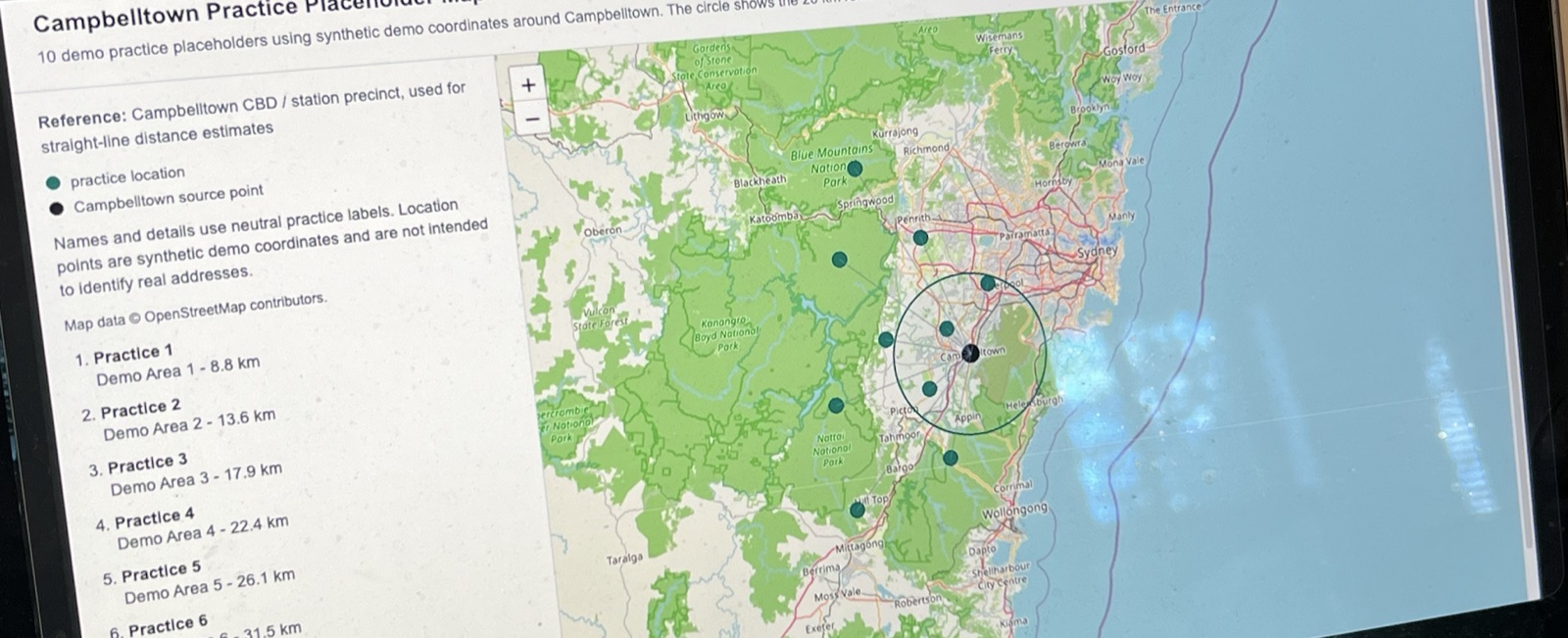
- Create an interactive map of the top options to show distance and location
This wasn't a request for a final answer, it was a request for a structured starting point based on the criteria I gave it to use.
After about 30 minutes of working, Codex had produced a ranked shortlist, contact details, notes, a spreadsheet and an interactive map.
That alone was useful, but what surprised me most wasn't the output. It was where Codex started.
Starting with the right authoritative source
One of the things that surprised me was that Codex did not begin with a broad web search.
It went first to the official authority directory for that specialist therapy approach, where practitioners trained or registered in that approach are listed.
That was exactly the right first source to use.
I noticed it immediately because it is the kind of source I would want to check myself. In fact, as a human, I might normally start with a general search first, then use the official directory as a second step once I had refined what I was looking for.
Codex did it the other way around. It started with the authority source first.
That changed my trust in the research process because it signalled that the search was beginning in the right place, not just with the most visible search result.
In a search like this, the first source shapes the quality and relevance of the whole list. If you start with a broad web search, the first results may be paid ads, strong SEO pages, local map results or general clinic listings. Some of those might be useful, but they still need filtering against the actual criteria.
Starting with the official directory made the first filter stronger. It meant the search began with providers who appeared to have a public connection to the specialist approach, then moved into the practical layer of checking location, websites, contact details, reviews and summaries.
That was the first moment where I thought: this is doing the research in the right order.
Why the map mattered
The interactive map was more useful as I wanted a visual map of the top providers so I could see, at a glance, how far away they were in real travel terms.
Location is not a minor detail in care admin. A provider can look suitable on paper but still be hard to access in real life. Travel time matters. Parking, public transport and appointment timing matters. Whether someone can realistically get there matters.
A map made the shortlist easier to understand because it turned a spreadsheet into something spatial and practical.
It helped answer a question that is easy to underestimate: is this option actually doable?
That is why the map mattered. It helped translate the search into real-life logistics, showing the radius around our target suburb and plotted out all the practices found.
The relief of a ranked shortlist
The ranked shortlist was also a relief because it turned scattered information into something reviewable.
Instead of notes and half-remembered websites, there was a spreadsheet, a Markdown report, contact details, short summaries and a map. The next step was no longer "keep searching." It became "review this list and decide who to contact first."
That's a very different feeling.
What still needed human checking
This kind of personal AI research task is a starting point, not a recommendation. While Codex relieved the burden of the first pass research, it wasn't filtering recommendations for me.
There were still important things to verify manually, including:
- registration or certification status
- current availability
- fees
- waitlists
- whether the provider is still offering the specialist approach
- whether the contact details are current
- whether the practice works with the relevant need
- overall suitability
- online reviews, while remembering that reviews are only one practical signal
That last point matters. Google reviews can be useful as a practical signal, but they are not clinical evidence. A review score does not tell you whether someone is the right fit, whether they have current availability, or whether the approach is suitable.
So I would not treat an AI-ranked list as a final answer. Rather it was a solid place to start to cut down on the manual searching, filtering, qualifying.
In this case, that was enough to make a heavy task feel more manageable.
Could the same search start by voice?
After running the typed search, I started thinking about another part of the problem.
My prompt was only a paragraph or two, but even that assumes a certain level of typing, confidence and energy.
What if typing a good enough prompt is itself a barrier?
For a task like this, someone may already be tired, stressed or juggling a lot. They may know what they need, but not have the time, energy or capacity to sit down and type a structured brief.
So I wanted to test whether the same kind of search could start by voice. Could someone speak a messy version of what they need, closer to natural speech, and have the system turn that into a structured research task?
That accessibility question is important. It's not only whether AI can search, it's whether someone can start the search without needing to type heavily or write a perfect prompt to start it.
For personal AI to be genuinely useful, it needs to work with how people actually ask for help. Sometimes that might mean a detailed typed brief. Sometimes it might mean speaking a messy first version and letting the system help structure it.
That could make a big difference for people who find manual typing difficult, or for anyone trying to get a heavy task out of their head quickly.
What this taught me about personal AI
This search reinforced something I have been thinking about throughout my personal AI experiments: the most useful AI use cases are not always the most impressive ones.
Sometimes the useful AI use case is the one that will not go viral.
For me, this is where personal AI starts to become genuinely interesting. Not as a system that takes over decisions, but as a support layer that helps with the messy middle of life admin.
The messy middle is where tasks often get stuck. You know something needs doing, but the search feels too broad. You know there are probably good options, but the information is scattered. You know you need to make a decision, but first you have to gather enough information to make that decision possible.
That is where AI can help.
It can reduce the load of getting started, gather and structure information, start with a better source, and turn an overwhelming search into something you can review.
And to be clear, that's not outsourcing judgment, or providing recommendations, it's supporting the heavy admin process around finding support.
What this means for allied health practitioners and care providers
One unexpected part of this experiment was that it made me think differently about practitioner websites.
If AI agents are increasingly helping people with first-pass research, then the quality of public information on a practice website matters even more. Not just for humans reading the site, but for the AI's helping people find, compare and shortlist possible support.
That doesn't mean every provider needs a complicated website. It means the basics still matter.
Can someone quickly see what approaches you are trained in? Do you clearly list who you work with, where you are located, what services you offer, and how to contact you? Is your specialist training or registration clearly explained? Are your details current? Is there enough information for both people and AI agents to understand whether you may be relevant to their search?
For specialist services, this becomes even more important. If someone is looking for a practitioner trained in a particular therapy or approach, it helps if that information is easy to find, written clearly, and backed up by the relevant registration, certification or directory listing where appropriate.
The clearer the public information is, the easier it becomes for someone doing a difficult search to understand whether you might be a good next step.
The takeaway
Some life admin is annoying and some is heavy.
Finding the right support sits in the heavy category because the stakes feel higher, the search is more specific, and the responsibility is harder to put down.
Using Codex for this search didn't remove the need for care, judgment or verification, but it did reduce the first-pass burden.
It started with the right authority source. It turned scattered information into a ranked shortlist. It mapped the options. It saved the details into formats that could actually be reviewed. It gave us a clearer path to the next step.
That feels like a meaningful use case for AI.
Not because it replaces human decision-making, but because it helps people get to the point where a human decision is possible.
Side note: AI can make mistakes, and this post is not medical, health or clinical advice. It is a reflection on how I used Codex to help with the first-pass research process for finding local providers. The final decision still needs human judgment, and any provider details, registration status, suitability, availability, fees or waitlists should be checked directly with the provider or a qualified professional.